
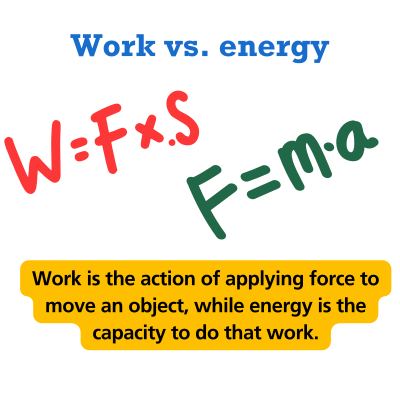
Work and energy are foundational concepts in physics that power everything from smartphones to spacecraft. Energy is the stored potential to cause change, while work is the actual process of transferring that energy through force and motion. This comprehensive guide clarifies their differences with formulas, everyday examples, solved problems, and practical insights for students and educators.
Key takeaways
- Energy is capacity; work is transfer — both measured in joules (J).
- Work = F × d × cos(θ); zero when force is perpendicular to motion.
- Work-energy theorem: Net work = ΔKE.
- Energy transforms but is conserved in closed systems.
- Daily activities like walking, charging devices, and driving involve constant energy-work cycles.
Table of Contents
What is Work and Energy?
Energy is the ability to do work or cause change. It exists in multiple forms and is a scalar quantity always conserved in isolated systems.
Work is the transfer of energy when a force moves an object over a distance in the direction of the force. Work can be positive (energy added), negative (energy removed), or zero.
Types of Energy
- Kinetic Energy: KE = 1⁄2mv2
- Gravitational Potential Energy: PE = mgh
- Elastic, Thermal, Chemical, Electrical, Nuclear
Why the Distinction Matters
Misunderstanding work vs. energy leads to errors in exams, engineering (e.g., efficiency calculations), and safety (e.g., braking systems).
Example: A satellite in orbit — gravitational force is perpendicular to velocity, so work = 0, and speed remains constant despite continuous force.
Causes of Confusion
Language & Units
- Everyday speech: “I did a lot of work” ≠ physics definition.
- Both use joules (1 J = 1 N·m).
- Work changes energy: W = ΔE
Formulas and Detection
Work Done by a Constant Force
W = F × d × cos(θ)
Where: F = force (N), d = displacement (m), θ = angle between F and d
Total Mechanical Energy
E = KE + PE = 1⁄2mv2 + mgh
Everyday & Solved Examples
Everyday Examples
- Pumping air into a tire: Energy stored as pressure; riding the bike does work.
- Boiling water in a kettle: Electrical energy → thermal energy; steam does work on a turbine.
- Climbing stairs: Chemical energy (food) → work against gravity → gravitational PE.
- Braking a car: Kinetic energy → heat via friction (negative work).
- Photosynthesis: Solar energy → chemical energy in glucose; your body does work using it.
- Charging a laptop: Grid energy stored; typing converts to mechanical work and heat.
Solved Example 1: Lifting a Book
Q: A 2 kg book is lifted 1.5 m vertically with constant speed. Calculate work done by the person. (g = 10 m/s²)
Solution:
F = mg = 2 × 10 = 20 N
d = 1.5 m, θ = 0° → cos(0) = 1
W = F × d × cos(θ) = 20 × 1.5 × 1 = 30 J
This work increases the book’s gravitational potential energy by 30 J.
Solved Example 2: Pushing a Box
Q: A 50 N force pushes a box 8 m at 30° to horizontal. Find work done.
Solution:
W = F × d × cos(θ)
W = 50 × 8 × cos(30°) = 50 × 8 × (√3/2) = 400 × 0.866 ≈ 346 J
Comparison Table
| Aspect | Work | Energy |
|---|---|---|
| Definition | Transfer of energy via force over distance | Capacity to do work |
| Formula | W = F×d×cos(θ) | E = KE + PE |
| Units | Joules (J) | Joules (J) |
| Sign | +, −, or 0 | Always positive |
| Example | Lifting a weight | Raised weight has PE |
Prevention of Calculation Errors
- Identify the direction of force vs. displacement — use cos(θ).
- Apply work-energy theorem: W_net = ΔKE.
- For conservative forces, use ΔPE = −W_gravity.
- Check units: 1 J = 1 kg·m2/s2.
- Draw free-body diagrams to avoid missing forces.
Summary & Conclusion
In physics, energy is the currency of the universe — the ability to cause change. Work is the transaction — how energy moves from one form or object to another. Whether you’re charging a phone, climbing stairs, or launching a rocket, every action involves this energy-work cycle.
Master these concepts, and you unlock the ability to analyze motion, design machines, and understand the physical world. Remember: energy is conserved, work is calculated, and real-world examples are all around you.
Frequently asked questions
What is the main difference between work and energy?
Energy is the capacity to do work; work is the actual transfer of energy via force and displacement.
When is work zero even if force is applied?
When force is perpendicular to displacement (θ = 90°, cos90° = 0), e.g., carrying a bag horizontally.
How does negative work affect energy?
It reduces the system’s energy, e.g., friction slows a sliding box, converting KE to heat.
What is the work-energy theorem?
Net work done on an object equals the change in its kinetic energy: W_net = ΔKE.
Can energy be destroyed?
No. Energy is conserved — it only changes form or transfers between objects.
