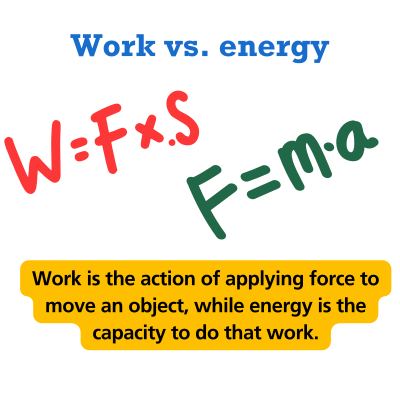
Key takeaways
- Energy is capacity; work is transfer — both measured in joules (J).
- Work = F × d × cos(θ); zero when force is perpendicular to motion.
- Work-energy theorem: Net work = ΔKE.
- Energy transforms but is conserved in closed systems.
- Daily activities like walking, charging devices, and driving involve constant energy-work cycles.
Table of Contents
What is Work and Energy?
Energy is the ability to do work or cause change. It exists in multiple forms and is a scalar quantity always conserved in isolated systems.
Work is the transfer of energy when a force moves an object over a distance in the direction of the force. Work can be positive (energy added), negative (energy removed), or zero.
Types of Energy
- Kinetic Energy: KE = 1⁄2mv2
- Gravitational Potential Energy: PE = mgh
- Elastic, Thermal, Chemical, Electrical, Nuclear
Why the Distinction Matters
Misunderstanding work vs. energy leads to errors in exams, engineering (e.g., efficiency calculations), and safety (e.g., braking systems).
Example: A satellite in orbit — gravitational force is perpendicular to velocity, so work = 0, and speed remains constant despite continuous force.
Causes of Confusion
Language & Units
- Everyday speech: “I did a lot of work” ≠ physics definition.
- Both use joules (1 J = 1 N·m).
- Work changes energy: W = ΔE
Formulas and Detection
Work Done by a Constant Force
W = F × d × cos(θ)
Where: F = force (N), d = displacement (m), θ = angle between F and d
Total Mechanical Energy
E = KE + PE = 1⁄2mv2 + mgh
Everyday & Solved Examples
Everyday Examples
- Pumping air into a tire: Energy stored as pressure; riding the bike does work.
- Boiling water in a kettle: Electrical energy → thermal energy; steam does work on a turbine.
- Climbing stairs: Chemical energy (food) → work against gravity → gravitational PE.
- Braking a car: Kinetic energy → heat via friction (negative work).
- Photosynthesis: Solar energy → chemical energy in glucose; your body does work using it.
- Charging a laptop: Grid energy stored; typing converts to mechanical work and heat.
Solved Example 1: Lifting a Book
Q: A 2 kg book is lifted 1.5 m vertically with constant speed. Calculate work done by the person. (g = 10 m/s²)
Solution:
F = mg = 2 × 10 = 20 N
d = 1.5 m, θ = 0° → cos(0) = 1
W = F × d × cos(θ) = 20 × 1.5 × 1 = 30 J
This work increases the book's gravitational potential energy by 30 J.
Solved Example 2: Pushing a Box
Q: A 50 N force pushes a box 8 m at 30° to horizontal. Find work done.
Solution:
W = F × d × cos(θ)
W = 50 × 8 × cos(30°) = 50 × 8 × (√3/2) = 400 × 0.866 ≈ 346 J
Comparison Table
| Aspect | Work | Energy |
|---|---|---|
| Definition | Transfer of energy via force over distance | Capacity to do work |
| Formula | W = F×d×cos(θ) | E = KE + PE |
| Units | Joules (J) | Joules (J) |
| Sign | +, −, or 0 | Always positive |
| Example | Lifting a weight | Raised weight has PE |
Prevention of Calculation Errors
- Identify the direction of force vs. displacement — use cos(θ).
- Apply work-energy theorem: W_net = ΔKE.
- For conservative forces, use ΔPE = −W_gravity.
- Check units: 1 J = 1 kg·m2/s2.
- Draw free-body diagrams to avoid missing forces.
Summary & Conclusion
In physics, energy is the currency of the universe — the ability to cause change. Work is the transaction — how energy moves from one form or object to another. Whether you're charging a phone, climbing stairs, or launching a rocket, every action involves this energy-work cycle.
Master these concepts, and you unlock the ability to analyze motion, design machines, and understand the physical world. Remember: energy is conserved, work is calculated, and real-world examples are all around you.
Frequently asked questions
What is the main difference between work and energy?
Energy is the capacity to do work; work is the actual transfer of energy via force and displacement.
When is work zero even if force is applied?
When force is perpendicular to displacement (θ = 90°, cos90° = 0), e.g., carrying a bag horizontally.
How does negative work affect energy?
It reduces the system's energy, e.g., friction slows a sliding box, converting KE to heat.
What is the work-energy theorem?
Net work done on an object equals the change in its kinetic energy: W_net = ΔKE.
Can energy be destroyed?
No. Energy is conserved — it only changes form or transfers between objects.